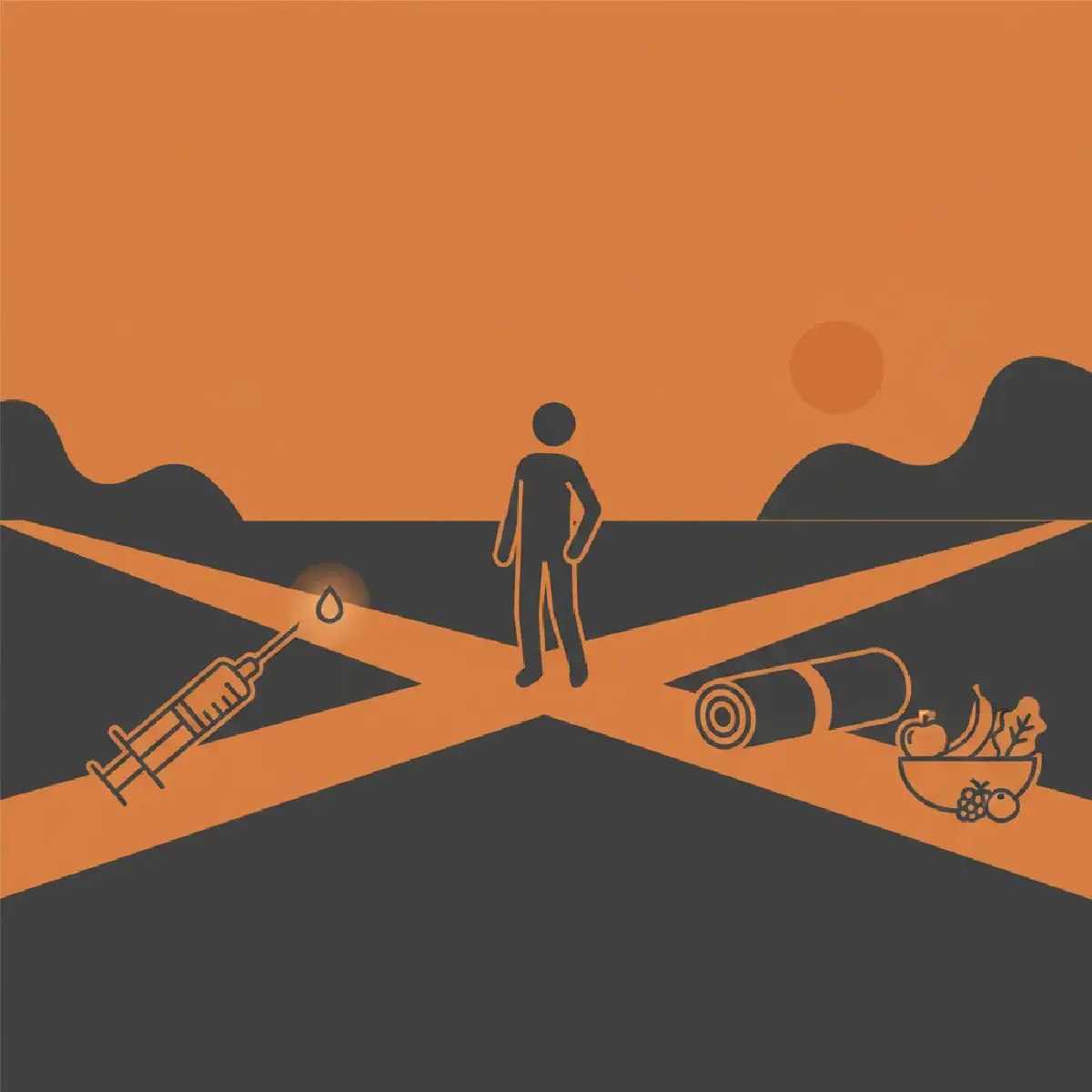

If you’ve been reading this series, you know how the drug works and what the fine print says. Now I want to talk about the hardest question: who actually needs it?
I have a stake in this question. I’m losing weight without it. I’m 40+ days into an exercise streak, down 18 pounds, doing the protein-and-yoga thing every single day. My whole brand, if you can call it that, is built on the idea that you can show up for yourself without a prescription.
But I also did the research. And the research made me more complicated than I wanted to be.
What Happened When People Just Fixed Their Diet #
Let me tell you about the DiRECT trial, because it’s the most important study you’ve never heard of.
UK researchers took adults with type 2 diabetes, diagnosed within the last 6 years, and gave them a radical intervention: stop all diabetes and blood pressure medications, go on a total diet replacement of 825-853 calories per day for 12-20 weeks, then transition to structured food reintroduction with ongoing support.
Year 1 results: 46% of the intervention group achieved diabetes remission. No medication. Just diet and weight loss.
Of the people who maintained at least 10 kilograms of weight loss through year 2, 81% were in remission.
That’s an extraordinary result. The conservative medical establishment, for all its love of pharmaceuticals, produced a trial showing that nearly half of type 2 diabetics could reverse their diagnosis through food alone.
The 5-year follow-up data (published February 2024) tells the rest of the story: 13% were still in remission at year 5. Of those who hit remission at year 2, 26% held it at year 5.
Over the entire 5 years, the intervention group spent an average of 27% of their time in diabetic remission, versus 4% for the control group. Still a meaningful difference. But the year 1 number and the year 5 number are not the same number, and both matter.
The enemy was weight regain. When the weight came back, the disease came back. Not because the intervention failed, but because maintaining significant weight loss over multi-year periods is one of the hardest things a human being can be asked to do.
The Prevention Number #
Before we get to treatment, here’s a fact from the Diabetes Prevention Program that I think about a lot.
Intensive lifestyle intervention, diet and exercise, reduced the incidence of type 2 diabetes by 58% in high-risk individuals.
Metformin, the most common first-line diabetes medication, reduced incidence by 31%.
Lifestyle was nearly twice as effective as the drug at prevention. This is not a cherry-picked finding. It’s foundational. It’s in every diabetes prevention guideline. The medical system knows this.
The question the DiRECT trial answered is: okay, but what about after someone already has the disease? And the answer is: diet still works for a lot of people, but sustained remission is hard.
Who the Criteria Actually Target #
The FDA approved Wegovy (high-dose semaglutide) for:
- BMI 30 or higher (obesity), OR
- BMI 27-29.9 (overweight) with at least one weight-related comorbidity: hypertension, type 2 diabetes, dyslipidemia, or sleep apnea
- As an adjunct to reduced-calorie diet and increased physical activity
Note that last line. “As an adjunct to.” Not a replacement for. The guideline explicitly includes diet and exercise as part of the treatment. The drug is supposed to be additive, not a substitute.
In December 2025, the WHO released its first-ever global guideline on GLP-1s for obesity. Their recommendation: BMI 30 or higher. As part of a comprehensive approach including healthy diet, regular physical activity, and professional support.
The clearest medical case for these drugs is patients with T2D plus obesity (the drug addresses both simultaneously), or patients with established cardiovascular disease plus significant obesity (the SELECT trial population I wrote about in part one). People who have genuinely tried lifestyle modification with appropriate support and have documented, serious weight-related health consequences.
Not: “I’m a bit soft and my doctor on the app said I qualify.” Not: “I want to lose 20 pounds before summer and willpower is hard.” Not: someone who hasn’t meaningfully tried the boring stuff.
The Telehealth Gap #
A 2025 survey of over 2,000 primary care physicians found that 56% of them cited overprescribing as their top concern with telehealth-driven GLP-1 prescriptions. More than half of PCPs require patients to try non-pharmacological approaches before they’ll prescribe GLP-1s themselves.
The issue isn’t the drug. The issue is the mechanism of distribution. A telemedicine platform with a financial incentive to approve subscriptions is not the same as a doctor who knows your full medical history, has documented your previous weight loss attempts, and is going to monitor your bone density and lean mass over time.
Both things can be true: the drug is legitimately valuable for a specific population, and the way it’s currently being handed out doesn’t match the intended population.
What Both Sides Get Wrong #
Here’s the thing the research actually says, and it’s the thing I want to leave you with.
The habits matter more on GLP-1s, not less.
If 45% of weight lost with semaglutide is lean mass, and the mitigation for that is protein and resistance training, then someone on Ozempic who is not doing protein and resistance training is losing nearly half their weight as muscle. Which is not what anyone is signing up for.
If bone density declines proportionally to weight lost, then weight-bearing exercise and adequate calcium aren’t optional lifestyle suggestions, they’re protective medicine.
If two-thirds of weight comes back within a year of stopping, and the primary defense against that is lifestyle habits that can sustain after the drug is gone, then the people who build real habits while on the drug are the ones with a chance at keeping the results.
The habits this brand is built on are not canceled by medication. They’re what protect you while you’re on it, and what keep you going if you ever stop.
My Honest Answer #
I’m not on these drugs. I started from scratch on New Year’s Eve, wall pushups in my living room, Diet Coke in the fridge, no plan. I found a method, I stuck to it, and 18 pounds later, it’s working.
My BMI, starting out, was 34.1. That’s clinical obesity. By the FDA’s criteria, I technically qualified for Wegovy on day one.
I chose not to take it. That was my choice, and it was the right choice for me, because I wanted to know if I could. Because building the habits felt like the point.
But I don’t think less of someone with a BMI of 35 and type 2 diabetes and elevated cardiovascular risk who looks at the SELECT trial data and says “I need help.” That’s not a moral failure. That’s a person dealing with a serious disease using a serious tool that has real evidence behind it.
What I do think is that a lot of people are taking these drugs who don’t fit that description. And the drug companies aren’t going to tell them that. The telehealth apps aren’t going to tell them that. So someone has to.
Do the hard work first. If you’ve genuinely tried and you have a clinical indication, the drugs are real and they work. But most people haven’t genuinely tried.
The boring stuff is still the boring stuff. Protein. Movement. Sleep. Consistency. The streak.
That’s what works, with or without the injection. Let’s burn the excuse and find out.
Sources #
- DiRECT trial: diabetes remission through diet, year 1 (Lancet, 2018)
- DiRECT trial: 5-year follow-up (Lancet Diabetes & Endocrinology, 2024)
- Diabetes Prevention Program: lifestyle vs metformin (NEJM, 2002)
- WHO guideline on GLP-1 medicines for obesity (WHO, 2025)
- PCP survey on telehealth GLP-1 prescribing concerns (Omada Health, 2025)